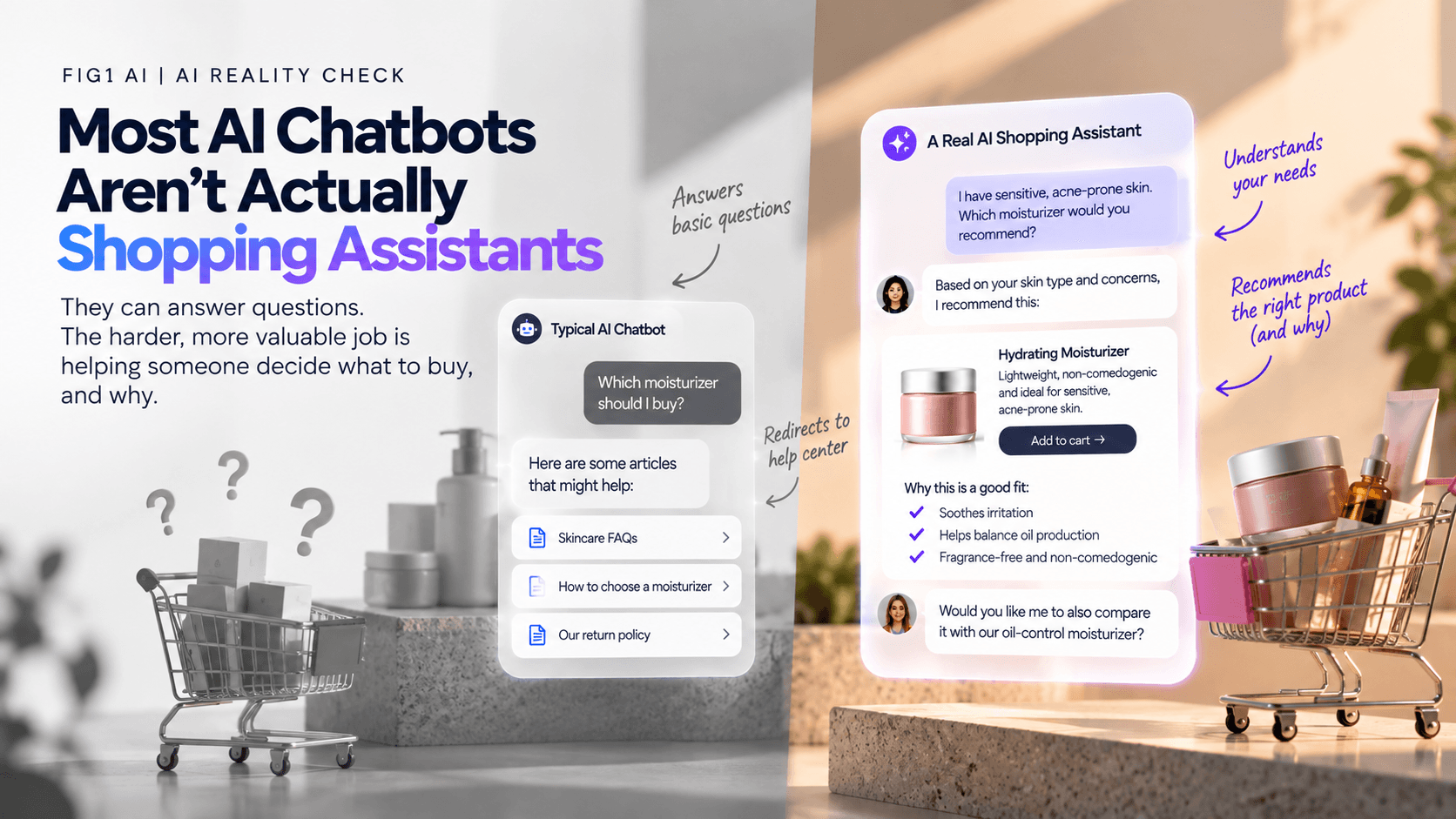
AI chatbots have become remarkably good at answering questions. But answering a question and helping someone decide what to buy are two very different jobs. For ecommerce brands, that distinction matters.
There’s a familiar moment in online shopping that ecommerce still hasn’t solved particularly well. You’re looking at two products from the same brand. They’re close in price, the descriptions sound similar, both have strong reviews, and after opening six tabs to figure out the difference, you somehow know more but feel less certain about what to buy.
In a store, this is usually the moment you look for someone who knows the products. You explain what you need, what matters to you and maybe what you don’t care about. A good salesperson doesn’t respond by reading both product descriptions back to you. They listen, ask a question or two and tell you which option makes more sense—and why.
That is shopping assistance.
Most ecommerce chatbots, despite increasingly sophisticated AI behind them, still aren’t very good at it.
The Difference Between Answering and Advising
The first generation of ecommerce chatbots had a fairly narrow job. They answered questions about shipping, returns, order status, store hours and other common support issues. That was useful then, and it remains useful now. Every question resolved automatically is one less ticket for a customer service team.
Generative AI has made those interactions much better. Customers no longer need to phrase a question exactly the right way or work through a rigid decision tree. Modern systems can understand natural language, retrieve information from larger knowledge bases and respond in a way that feels much more conversational.
But making the conversation better doesn’t necessarily change the job being done.
Ask an ecommerce chatbot, “What is your return policy?” and there is a correct piece of information somewhere for it to retrieve. Ask, “Which of these two products should I buy?” and there may be no single answer sitting in a knowledge base.
Now the AI has to understand the customer, understand the products, determine which differences actually matter in this particular situation and turn all of that into a recommendation.
That is a fundamentally different problem.
What Is an AI Shopping Assistant?
An AI shopping assistant is an ecommerce AI agent designed to help customers discover, compare, evaluate and choose products through conversation.
The most important word in that definition is choose.
A chatbot can tell a shopper that one jacket uses a 650-fill insulation and another uses 800-fill. A shopping assistant should be able to ask where the customer lives, how they plan to use the jacket and whether warmth, weight or price matters most—and then explain which jacket makes more sense for them.
A chatbot can tell you the dimensions of three sofas. A shopping assistant should be able to understand that you have a small living room, two kids, a dog and a preference for something easy to clean, then narrow the catalog accordingly.
A chatbot retrieves information. A shopping assistant helps make that information useful.
That distinction is becoming increasingly important as AI moves deeper into ecommerce.
Shoppers Rarely Arrive With Perfectly Formed Questions
One reason conventional chatbots struggle with shopping is that shopping rarely begins with a clean question.
Customers arrive with needs, preferences, uncertainties and constraints that are often only partially formed. Someone shopping for a mattress might know that they sleep on their side, get hot at night, share the bed with a partner and would prefer to spend less than $2,000. They may have no idea what firmness level, material or construction type they should be searching for.
Traditional ecommerce asks that customer to translate their situation into the language of the catalog. Choose a category. Apply some filters. Read product pages. Open comparison charts. Search reviews. Go back. Change the filters. Repeat.
A good shopping assistant reverses that relationship.
The customer can simply say:
“I sleep on my side, I get hot at night, my partner moves around a lot, and I’d like to stay under $2,000.”
That one sentence may contain more useful buying intent than ten filter selections.
The role of the AI is to interpret that intent, identify the products that fit and explain why they fit.
This is where conversational commerce becomes much more than putting a chat interface on a website.
Product Discovery Is Often a Language Problem
Ecommerce catalogs are organized around products. Customers think in terms of their lives.
That creates a surprisingly large gap.
A retailer might organize outdoor furniture by collection, material, dimensions and SKU. A shopper might be thinking, “I need something that can stay outside all summer, fit on a small balcony and survive two kids.”
A beauty brand might organize skincare by product type, ingredient and concern. A customer might say, “My skin feels dry by the afternoon, but heavy moisturizers make me break out.”
A wine retailer might organize its catalog by varietal, region and price. The shopper may simply want “a bottle to bring to dinner that works with steak and feels nice enough to give as a gift.”
Search engines and filters require customers to know how the retailer describes the solution.
An AI shopping assistant has the potential to understand the problem first and map it back to the catalog.
That changes product discovery from find the right words to tell us what you need.
Recommendations Need a Reason
There is another important difference between search and assistance: a recommendation needs to be defensible.
Showing someone five products labeled “Recommended for You” is not necessarily guidance. Neither is returning the first three products that match a keyword.
A useful recommendation should answer two questions:
Why this product? And why this product for me?
Imagine a shopper choosing between two nearly identical coffee machines. One is $200 more expensive and includes additional temperature control, programmable profiles and a larger boiler. The shopper makes one coffee each morning and mainly wants something reliable and easy to use.
A strong shopping assistant should be comfortable saying that the less expensive machine is probably the better choice.
That matters.
The goal of AI-assisted commerce should not be to push the highest-priced product in every interaction. It should be to increase the shopper’s confidence that they are making the right decision.
Sometimes that means trading a customer up. Sometimes it means telling them they don’t need to.
Over time, that kind of guidance can be far more valuable to a brand than an aggressive upsell.
A Real Shopping Assistant Needs More Than a Product Feed
This is where many current AI implementations run into trouble.
Connecting a language model to a product catalog is relatively straightforward. Creating an assistant that actually understands how a brand sells is much harder.
A capable AI shopping assistant needs access to product information, but it also needs the context surrounding those products: positioning, intended use cases, meaningful differences between models, compatibility, customer types, common objections, merchandising priorities and the circumstances in which one product should be recommended over another.
Consider a brand selling three versions of the same product: good, better and best.
The product feed can tell an AI that they cost $99, $149 and $229. It can list the specifications of each.
What it may not tell the AI is that the $149 model is the right choice for most customers, the $229 version is really intended for professionals, and the $99 model is best suited to occasional use.
That is merchandising knowledge.
A great salesperson learns it. A useful AI shopping assistant needs to learn it too.
The Conversation Should Change as the AI Learns
Another weakness in many ecommerce chat experiences is that every response behaves like the first response.
Real shopping conversations accumulate context.
If a customer has already told the assistant that they have a $500 budget, there is no reason to recommend a $900 product three messages later. If they say they live in a condo, that should influence subsequent recommendations about size. If they reject one option because of its style, the next recommendation should reflect that preference.
The conversation should become more useful with every exchange.
That means remembering what the shopper has said, knowing when to ask another question and—just as importantly—knowing when it has enough information to make a recommendation.
An assistant that asks fifteen questions before showing a product is frustrating. One that asks none is guessing.
The intelligence is partly in knowing the difference.
AI Shopping Assistants Can Change the Economics of Ecommerce
The opportunity here goes beyond customer service.
Most ecommerce optimization has historically focused on helping customers move through a predetermined funnel: improve navigation, improve search, optimize the product page, simplify checkout and recover abandoned carts.
AI introduces another possibility: improve the decision itself.
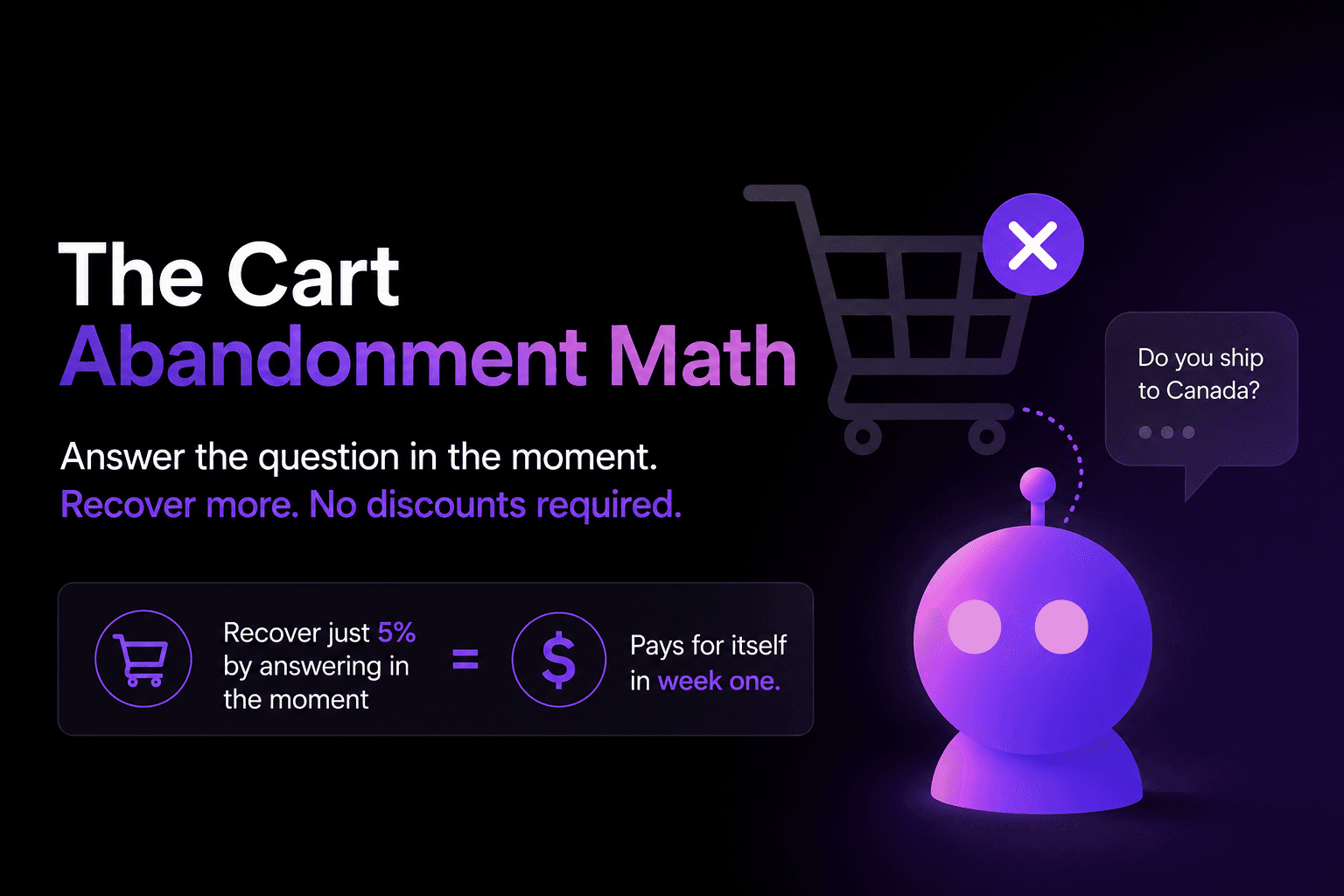
If a shopper can describe what they need and quickly reach a smaller, more relevant set of products, several valuable things can happen at once. Product discovery becomes easier. Comparisons become clearer. Relevant cross-sells become more natural. Higher-priced products can be justified when they genuinely fit the customer better. And shoppers may be less likely to abandon the site simply because they cannot figure out what to choose.
It also creates opportunities across the catalog.
A customer shopping for a grill may need tools, fuel, a cover and accessories. Someone choosing wine for dinner may also be making decisions in seafood, deli, cheese or prepared foods. A shopper buying a camera may need a lens, memory card, bag and tripod.
Traditional recommendation engines often approach these as “people who bought this also bought…”
Conversational commerce can approach them differently:
“Here’s what makes sense for what you’re trying to do.”
That is a much more powerful merchandising idea.
What Should Ecommerce Brands Look for in an AI Shopping Assistant?
The easiest way to evaluate an AI shopping assistant is not to ask how human it sounds. Ask what it can actually do.
Can it understand a customer who describes a need without knowing the product name? Can it ask useful follow-up questions? Can it compare products in plain language instead of repeating specifications? Can it explain why one product is a better fit than another? Can it remember preferences throughout the conversation? Can it recommend complementary products in context? Can it represent the brand’s actual merchandising logic rather than inventing its own? And can it move naturally from discovery to recommendation to purchase?
Those capabilities matter much more than whether the chatbot has a clever name or types with a convincing three-dot animation.
The interface is not the product.
The quality of the guidance is.
From Chatbot to AI Sales Agent
This is the shift we’ve been building toward at Fig.1 AI.
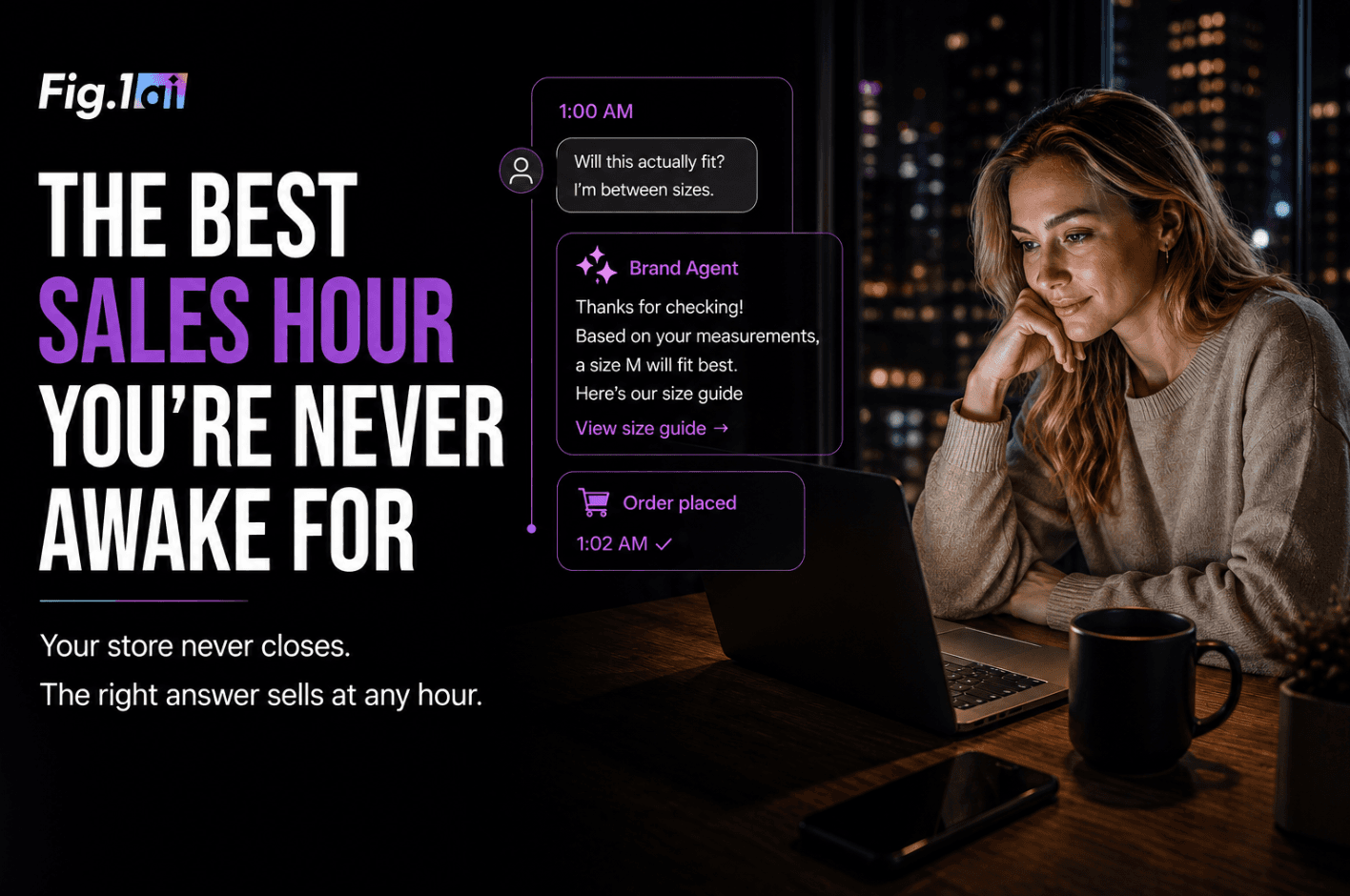
A Fig.1 AI Brand Agent isn’t designed simply to sit on a website and wait for someone to ask about shipping. It can be grounded in the brand’s product catalog, content, policies, positioning and voice so the conversation can extend into actual product discovery and decision-making.
That means a shopper can arrive without knowing exactly what they want.
The agent can help narrow the need, surface relevant products, explain the differences, answer questions, introduce complementary products where they make sense and continue helping until the customer has enough confidence to make a decision.
For brands, that creates an interesting new layer between browsing and buying.
It is not quite search. It is not customer support. It is not a traditional recommendation engine. And it is not simply another chatbot.
It is closer to putting a knowledgeable brand representative into the digital shopping journey.
The Future of Ecommerce AI Is Guidance
AI will continue to get faster. Models will get better at retrieving information, understanding natural language and generating polished responses.
Those improvements are important, but they are not the finish line.
A customer does not need a 300-millisecond answer to the wrong question.
They need help making the right decision.
That is why the next meaningful evolution in ecommerce AI is not simply a better chatbot. It is an AI shopping assistant that understands the customer, understands the catalog and can connect the two.
The best salespeople have always done exactly that.
They listen. They understand what matters. They know the products. They explain the tradeoffs. And when the customer is ready, they help them choose.
AI finally has the potential to bring that kind of guidance to every digital shopper.
The brands that get this right won’t simply answer more questions.
They’ll help more people buy with confidence.