The promise behind AI video creation is compelling: video production used to require cameras, crews, specialized talent, significant budgets, and weeks of work. Today, an AI video generator can turn a text prompt into a finished clip in minutes.
The barrier to making video has never been lower.
But that doesn’t mean the barrier to making good video has disappeared.
As AI video tools become more powerful and accessible, an important distinction is getting lost in the conversation:
AI has democratized video production. It has not yet democratized creative direction.
And that may be the biggest problem the next generation of AI video tools needs to solve.
Prompting an AI Video Is Directing
Anyone can access an AI video generator and create a clip. Getting an intentional, professional result is a different challenge.
Ask an AI video model for “cinematic lighting” and it has to make most of the creative decisions for you.
Specify the direction and quality of the light, the contrast, lens characteristics, depth of field, composition, subject movement, camera movement, pacing, and mood, and the result becomes far more controlled.
The difference isn’t simply better prompting.
Prompting is directing.
The knowledge required to create a compelling shot hasn’t disappeared. Cinematographers and directors understand how light changes emotion, how lens choice changes perspective, how composition directs attention, how camera movement creates energy, and how pacing affects an audience.
AI video generation changes how those decisions are executed. Instead of communicating them to a cinematographer, camera operator, lighting crew, editor, and production team, creators can increasingly communicate them directly to a model.
The interface changed. The need for creative judgment didn’t.
Why So Much AI-Generated Video Still Looks Like AI
AI video models are improving at an extraordinary pace. Realism is improving. Character consistency is improving. Motion is improving. Prompt adherence is improving. Generation times are falling.
And yet, there is still an enormous amount of AI-generated video that feels unmistakably AI-made.
The model isn’t always the problem. Often, the direction is.
Generic instructions tend to produce generic creative decisions. If the creator can’t articulate the shot they want — or doesn’t know which decisions need to be made — the AI has to fill in those gaps.
That’s how different creators using increasingly powerful models can still end up producing remarkably similar work.
Better generation does not automatically produce better creative direction. That distinction matters because the AI video industry is heavily focused on solving the former.
AI Video Is Already Transforming Production
None of this diminishes how significant AI video technology already is. In fact, it makes the current opportunity clearer.
For creative teams, marketers, art directors, filmmakers, and brands that already understand visual storytelling, AI video production removes an enormous constraint: the cost of experimentation.
Traditionally, every creative idea came with a production cost. A concept requiring a location, actors, lighting, equipment, editing, and a crew needed enough confidence behind it to justify producing it. That meant ideas were filtered before they were ever tested.
AI changes that equation. When an idea can move from concept to usable video dramatically faster, teams can test concepts they previously would have abandoned.
At Fig1.ai, some of the strongest AI video results have come from exactly those lower-conviction ideas — the “why not try it?” concepts that might never have survived a traditional production process.
That is one of the most important advantages of generative AI for creative teams. AI doesn’t just make production faster. It makes creative experimentation cheaper.
But cheaper experimentation only becomes valuable when someone can recognize which experiments are actually good. Creative judgment remains the multiplier.
AI Video Isn’t Replacing Creative Teams. It’s Giving Them Leverage.
This is where the claim that “AI turns everyone into a filmmaker” starts to fall apart.
AI video tools absolutely give more people the ability to generate moving images. That isn’t the same as giving everyone the ability to direct them.
Right now, AI video may actually provide the greatest advantage to people who already understand creative production:
- A director can explore more shots.
- An art director can visualize more concepts.
- A marketer can test more creative angles.
- A production team can create ideas that previously would have exceeded the available budget.
- A brand can move from concept to execution without assembling a traditional production pipeline for every piece of content.
The expertise isn’t eliminated. The expertise becomes dramatically more leveraged.
And that leads to a bigger question about where AI video needs to go next.
The Next AI Video Breakthrough Might Not Be a Better Video Model
Most of the competition in generative video is currently centered around the model itself:
- Better realism
- Longer generations
- More consistency
- Better physics
- Better audio
- More control
All of those improvements matter. But eventually, generating a technically impressive video may stop being the hardest problem.
The harder problem will be helping someone who doesn’t know how to direct create something worth watching. Because giving everyone a production studio doesn’t automatically give everyone a director.
So perhaps the next major opportunity in AI video isn’t another generation button.
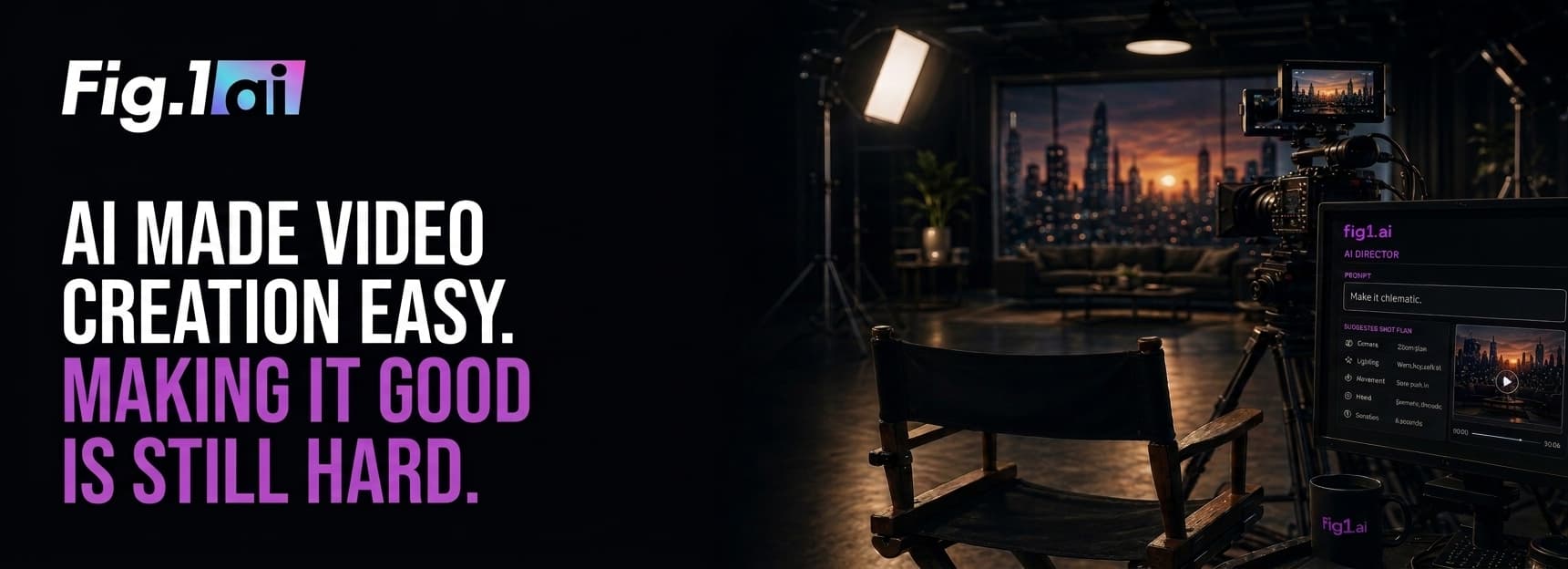
It’s an AI director.
Imagine an AI video tool that doesn’t wait for the user to know how to write the perfect prompt. Instead, it helps make the creative decisions.
The user says: “I want this product to feel premium.”
The system doesn’t simply translate that sentence into a video. It:
- Asks what premium should mean for this brand
- Recommends framing
- Proposes camera movement
- Understands when the lighting is wrong
- Identifies continuity problems
- Recognizes when a shot feels generic
- Suggests a stronger opening
- Helps select the best generation
- Determines where editing, sound design, pacing, or another shot is needed
In other words, it doesn’t just generate. It directs.
That may be the layer required to actually make high-quality AI video accessible to everyone.
Generation Is Only One Part of the Creative Process
There is another problem with treating AI video generation as the finished product: a great generation isn’t necessarily a great video.
Real video production involves much more than creating individual shots. There is editing, sequencing, sound design, music, pacing, performance, continuity, brand consistency, and story structure.
Knowing what to remove is often just as important as knowing what to generate.
The future of AI video therefore may not be a single model that creates a perfect finished video from one sentence. It may be an intelligent creative system that understands the entire production process — from idea to direction to generation to editing.
That is a fundamentally different product challenge.
The Real Race in AI Video
AI video generation is moving incredibly quickly, and access is becoming almost universal. That means access itself won’t remain a competitive advantage for long. Generation quality may not either.
If every creator eventually has access to models capable of producing technically beautiful footage, the differentiator becomes what humans have always struggled with:
What should we actually make?
That’s why the most important question facing AI video isn’t whether the technology will become good enough. It will.
The question is whether AI video tools will remain incredibly powerful instruments that require creative expertise — or whether someone will successfully build the creative intelligence layer that helps everyone else use them well.
At Fig1, the belief is that the future isn’t a blank prompt box. It’s AI that understands the brand, the content, the audience, and the creative direction behind what it’s being asked to make.
AI video has solved a huge part of the production problem. Now the industry needs to solve the director problem.
And whoever closes that gap may have a much bigger impact on the future of AI video than whoever simply generates the prettiest next frame.