For twenty years, the assumption underneath every ecommerce site was the same.
Shoppers would arrive. Scroll a grid. Filter. Compare tabs. Abandon a cart. Get retargeted on Instagram. Come back a week later. And maybe convert.
The page-based internet had a good run. It’s over.
That funnel is breaking in real time. Shoppers in 2026 don’t want to dig. They want to ask.
And the brands that understand this shift are quietly converting at rates the old funnel never touched.
The shift is already measurable
This isn’t a forecast. It’s already happening.
- Worldwide spend on conversational commerce channels is projected to hit ~$290 billion in 2026.
- Shoppers who engage with AI during their journey convert at roughly 4x the rate of shoppers who don’t.
- 79% of brands say AI-driven conversational commerce has lifted their sales.
- 71% of customers expect personalization — and 76% get frustrated when they don’t get it.
Read those numbers together and a single story emerges:
The customer journey isn’t a journey anymore. It’s a conversation.
Why the old playbook is failing
Static product pages were built for a world where the shopper already knew what they wanted.
They typed it into a search bar. They scrolled a grid. They filtered by size and price. They self-served.
That world is gone.
The new shopper opens a chat and types something like:
“I want a bold red under $40 to bring to a dinner party — something that’ll impress without being pretentious.”
A product grid can’t answer that. A FAQ can’t answer that. A keyword search definitely can’t answer that.
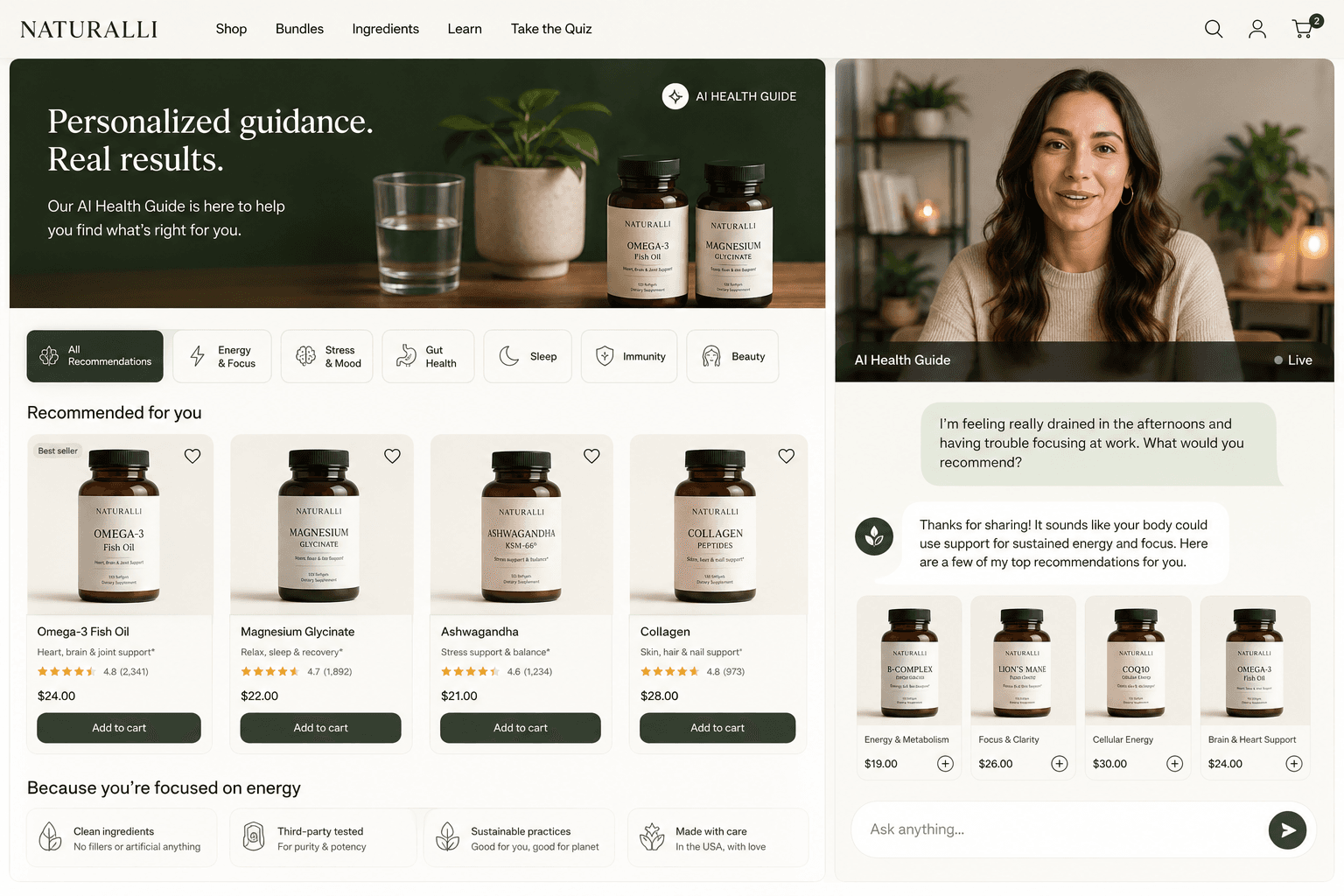
What that shopper needs is a brand voice that meets them at the moment of intent — one that can ask the follow-up question, show the right video, suggest the right product, and close the loop before the tab gets closed.
That is what conversational AI is for. And most brands are still doing it wrong.
The chatbot problem nobody wants to admit
Here’s the uncomfortable truth: most brand “chatbots” feel like a dead-end.
They’re a search bar in a speech bubble. No personality. No video. No real understanding. No memory.
The shopper asks one question, gets a robotic answer, closes the window, and goes to a competitor.
That’s not conversational commerce. That’s a contact form with a typing animation.
The brands winning right now treat their AI agent the way they treat every other touchpoint — as an extension of the brand itself:
- The way it talks.
- The content it surfaces.
- The video it plays at the right moment.
- The tone it uses with a hesitant buyer versus a returning one.
In other words: a brand agent, not a chatbot.
What “bringing a brand to life” actually means in 2026
A great in-store associate doesn’t just hand you a spec sheet.
They read the room. They ask what you’re trying to accomplish. They pull a product off the shelf. They tell a story about it. They show you how it works.
That’s the bar a real AI brand agent has to clear. And it requires four things most chatbots simply do not have:
1. A brand voice
Not a generic LLM tone, but a personality trained on how the brand actually talks.
2. Rich media
Video, product imagery, comparison cards, interactive elements. Text-only answers leave conversion on the table.
3. Real-time adaptation
The agent learns from every conversation and adjusts what it surfaces.
4. A feedback loop
Every question a customer asks is signal. What confuses them. What excites them. What stops them from buying.
Brands have never had this layer of insight before.
When those four come together, something interesting happens. The same shopper who would have bounced off a product grid now stays in conversation for three, four, five minutes — and converts at multiples of the site average.
Across categories — beverage, retail, hospitality, DTC — brands deploying rich-media brand agents are reporting chat-driven purchase lifts in the triple digits.
Conversion rates that match or beat live human agents. ROI multiples that make traditional support tooling look expensive by comparison.
This isn’t one industry’s story. It’s the same pattern repeating wherever shoppers have real questions and brands are willing to actually answer them.
The real unlock: AI has to show up everywhere the shopper does
Here’s the part most brands are still getting wrong: they put an AI agent on the website and stop there.
The shopper journey isn’t on the website. It’s on:
- The website
- The Instagram ad
- The landing page
- The QR code on the bottle
- The email link
- The in-store display
A single conversational AI experience that follows the shopper across all of those touchpoints — same voice, same memory, same brand — is what compounds the lift.
At Fig.1, we’ve seen this play out across the brands we work with — including BarDog, Foley Wines, Ferrari-Carano, and others.
The pattern is consistent. When a brand agent is deployed in one place, the lift is real. When the same agent shows up across online, social, and retail touchpoints together, the lift multiplies.
This is the omnichannel rule for the AI era.
The brands treating conversational AI as a website widget are leaving most of the upside on the table. The brands treating it as a brand-wide layer — one that meets the customer wherever they are — are the ones running away with the category.
The window to act is small
Roughly one in four shoppers is expected to use AI chatbots while shopping in 2026.
About one in three U.S. consumers says they’d let an AI complete purchases for them.
OpenAI has already wired in-chat checkout into Target, Instacart, and DoorDash.
The infrastructure is being poured right now. The brands that get inside these conversations early — with their voice, their content, their experience — become the default answer.
The brands that wait become invisible.
This is the same pattern that played out in mobile apps in 2010 and in social in 2014. The platforms shifted. The brands that moved early owned the new surface. The brands that hesitated paid 10x for the same attention two years later.
Conversational AI is that surface now.
The takeaway
Shoppers aren’t browsing anymore. They’re asking.
And the answer they get back is the brand experience.
If your answer is a generic chatbot, you don’t have a brand experience. You have a deflection tool.
The brands that win the next decade of commerce will be the ones whose AI agents feel like them — talk like them, look like them, sell like them.
Always on. Multilingual. Rich. Visual. Human-ish in the best possible way.
That’s the bar. And it’s lower than most brands realize, because the tooling to clear it already exists.
Build your brand agent with Fig.1 AI
Fig.1 AI’s platform turns your existing content — videos, product info, FAQs, campaigns — into a branded, rich-media AI agent in minutes. No code.
Deploy on your site, your landing pages, in-store QR codes, anywhere shoppers ask questions.


