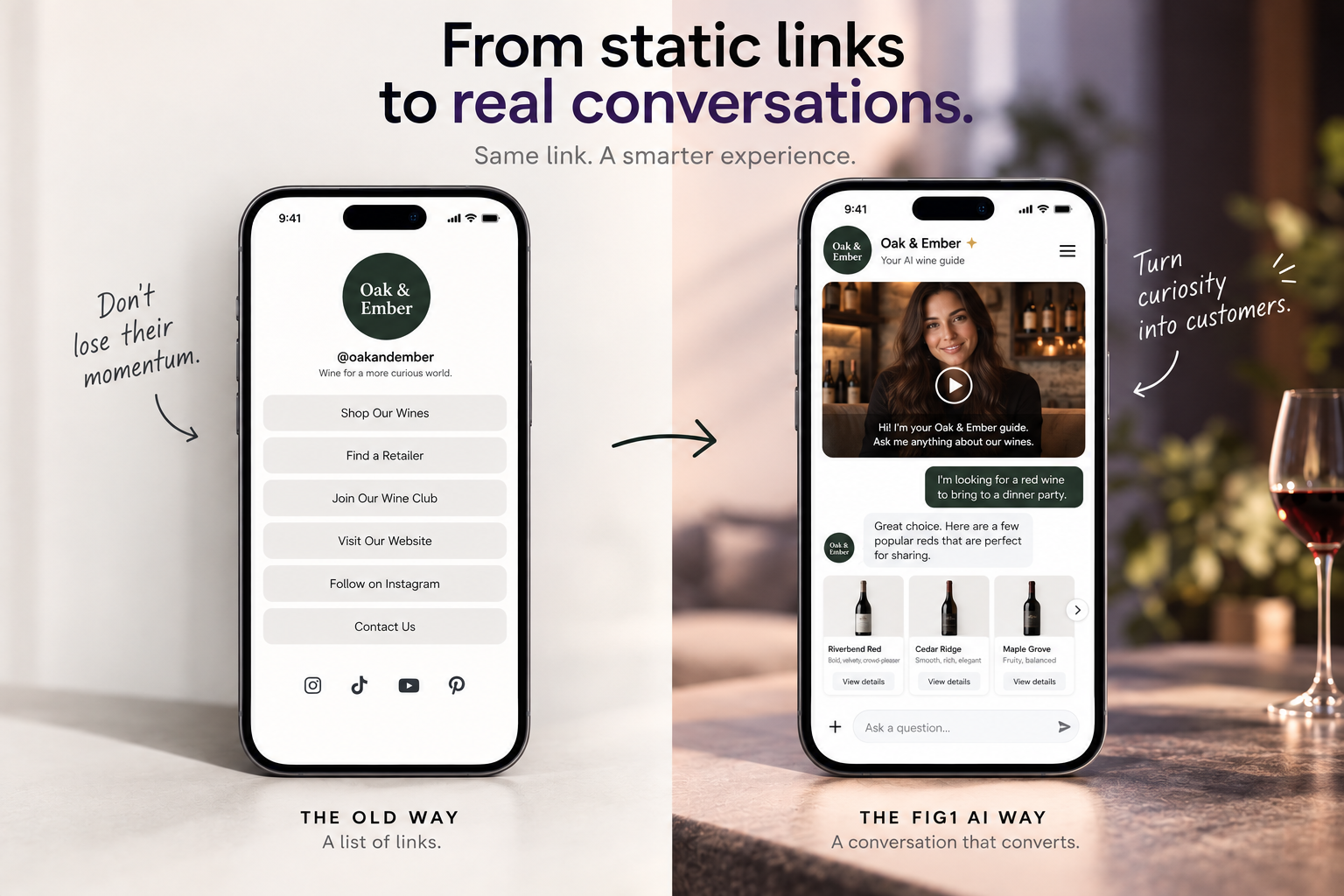
Your brand works hard to earn attention on social. What happens after someone clicks may be where you’re losing it.
You invest in content. Paid social. Creators. Influencers. Campaigns.
Someone discovers your brand, becomes interested enough to learn more, and taps the link in your bio.
That’s a valuable moment.
They’ve gone from scrolling to actively seeking something from you.
And what do most brands give them?
A list of links.
Shop. Learn More. About Us. Contact. Sign Up.
Now the work is back on the customer. They have to decide which link might contain the answer they need, navigate another page, search for information, and figure out what to do next.
Every additional step creates another opportunity to lose them.
You’re not just losing clicks. You’re losing intent.
Think about why someone taps your link in bio in the first place.
Maybe they just watched a creator talk about your product and want to know which version is right for them.
Maybe they saw a post about an event and want to know if it’s happening near them.
Maybe they discovered your gym and want to understand what a first class is actually like before committing.
Maybe they like what they saw, but they have one question standing between curiosity and a purchase.
These aren’t passive visitors.
They’re arriving with context, curiosity, and often a specific need.
But a traditional link-in-bio can’t ask what brought them there. It can’t answer their question. It can’t recommend the right product. And it can’t adapt the experience based on what they’re looking for.
It can only give them somewhere else to go.
And if they don’t find what they need quickly enough, that intent disappears with them.
What if your link in bio could actually help?
Instead of opening a directory, imagine someone tapping your link and entering an interactive, branded experience.
They ask:
“Which one is right for me?”
Your brand answers.
“Where can I buy this near me?”
Your brand helps them find it.
“I’ve never done this before. Where should I start?”
Your brand guides them.
“Can I see how this works?”
Your brand shows them a video.
That’s the opportunity behind an AI-powered link in bio.
The goal isn’t to add AI for the sake of adding AI. It’s to remove the gap between interest and action.
The link-in-bio is becoming conversational
The original job of a link-in-bio was routing.
Social platforms gave brands one link, so brands created a page with many.
It solved a real problem.
But customer behavior has changed.
People increasingly expect to ask questions and get relevant answers immediately. They encounter personalized recommendations across e-commerce, streaming, search, and social. AI is making conversational discovery increasingly familiar.
A static directory treats every visitor exactly the same.
A conversational experience can respond to why that individual visitor is there.
That’s a fundamentally different role for the link in your bio.
Instead of simply distributing traffic, it can help convert attention into engagement.
Introducing Fig1 AI Link-in-Bio
Fig1 AI turns your link in bio into an AI-powered Brand Agent built around your business.
It’s trained on your brand’s products, content, business information, expertise, and voice, so visitors can interact with your brand from the moment they click.
Your Brand Agent can:
- Answer customer questions in real time, 24/7
- Recommend relevant products, services, content, or next steps based on what someone needs
- Share videos, products, resources, and other rich media directly within the experience
- Guide visitors toward a purchase, booking, lead form, website page, or other call to action
- Capture leads and surface the questions and topics your audience cares about
- Communicate across languages and devices
- Keep every interaction aligned with your brand’s voice and expertise
Instead of asking every visitor to navigate the same menu, you’re helping each person find the path that’s relevant to them.
What does an interactive link-in-bio look like in practice?
For a winery, someone might arrive after seeing a bottle featured on Instagram. They can ask about tasting notes, get a recommendation based on what they usually drink, watch a pairing video, and find a retailer.
For a fitness brand or gym, a first-time visitor can ask what class is right for them, understand what to expect, watch a short video, and book an introductory session.
For an e-commerce brand, a shopper can describe what they’re looking for, compare products, get a recommendation, and move directly toward purchase.
For a creator or media brand, a follower can find the content, resource, product, or offer that’s most relevant to what brought them there.
Same link.
Very different journeys.
Because not everyone clicking your bio came for the same reason.
There’s another thing static link pages don’t tell you
When someone opens a traditional link-in-bio page, you may know what they clicked.
But you don’t necessarily know why.
That’s valuable information you’re leaving behind.
A conversational experience gives your audience a way to tell you what they want in their own words.
What questions keep coming up?
What products are people comparing?
What information are they struggling to find?
What are they looking for before they’re ready to buy?
Where are they getting stuck?
Those conversations aren’t just opportunities to help individual customers. They can become a source of insight into your audience.
Your link in bio can become more than a traffic-routing tool. It can become a listening channel.
From discovery to conversation to action
The social customer journey shouldn’t stop at the click.
It can look more like this:
Discover — Someone encounters your brand through social content, a creator, an ad, AI discovery, or a recommendation.
Ask — They click through with a question, need, or moment of curiosity.
Engage — Your Fig1 AI Brand Agent responds with information, recommendations, content, and guidance relevant to their intent.
Act — They buy, book, sign up, visit, watch, inquire, or connect with the right person.
And along the way, your brand learns more about what your audience actually wants.
That’s a very different experience from:
Click → Choose from six buttons → Search → Hopefully find the answer.
Your most valuable social click shouldn’t lead to a menu
Getting someone to stop scrolling is hard.
Getting them interested is harder.
Getting them to voluntarily click through to learn more is valuable.
Once they’ve done that, don’t make them start their search all over again.
Continue the experience.
Answer the question.
Help them decide.
Give them a clear next step.
The future of link-in-bio isn’t about adding more buttons to a page.
It’s about making the click more useful.
Fig1 AI turns your link in bio into a personalized, conversational brand experience—helping you turn social discovery into engagement, and engagement into action.


