There’s a reason customer research always feels one quarter behind. It was built on a workaround.
Surveys and dashboards were always a workaround
Surveys exist because businesses couldn’t listen to every customer conversation as it happened, so they sampled a slice of people after the fact and hoped it generalized. Dashboards exist because raw customer interactions were too messy and unstructured to analyze at scale, so businesses reduced them down to clicks, sessions, and conversion rates — numbers that show you the shape of what happened without ever telling you why.
Both are workarounds for the same missing thing: the ability to actually hear what customers are saying, at volume, without a person manually reading every transcript.
For most of the last twenty years, marketing and product teams didn’t have a choice. The tooling didn’t exist. So the entire “insights” industry — panels, focus groups, NPS, CSAT, attribution models — got built on top of that gap. All of it exists to reconstruct, imperfectly, what a customer would have told you directly if anyone was there to listen.
That gap is what just closed.
The conversation was always the research
Here’s what’s easy to miss: every question a customer asks your business is a data point you already have.
- “Does this work with what I already own?” is product-market fit feedback.
- “Is this available in my size?” is an inventory signal.
- “Why does this cost more than the other one?” is a pricing objection happening in real time, for free, without a focus group.
- “Do you ship to Canada?” asked five hundred times a month is a market expansion brief.
The problem was never that this information didn’t exist. It’s that it lived in inboxes, chat logs, and phone-call notes — unread, unsearched, and gone by the time anyone thought to look for a pattern.
What changes at scale
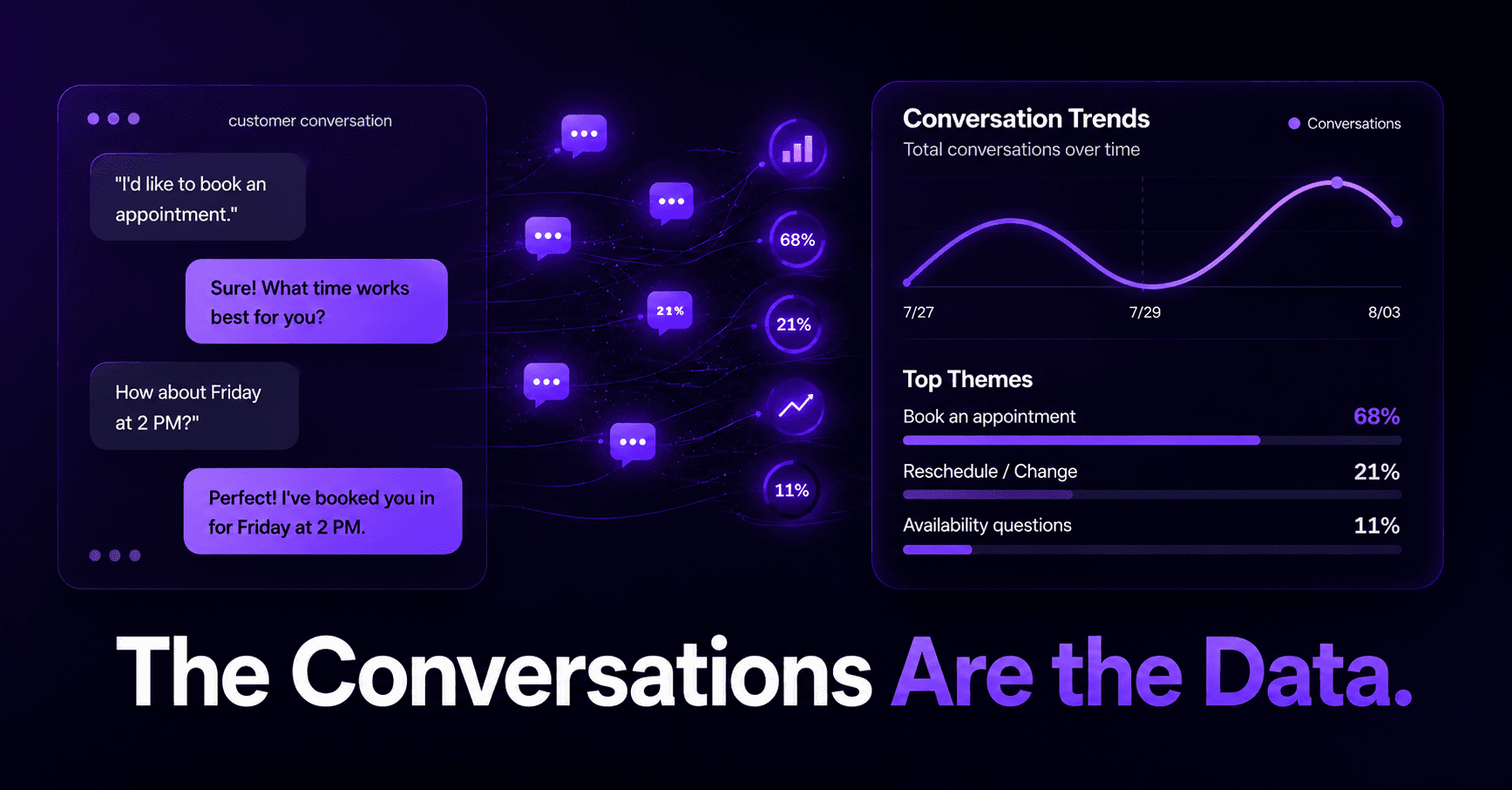
A Brand Agent doesn’t just answer these conversations. It logs every one of them as structured data, automatically, without anyone assigning a person to tag and categorize a spreadsheet.
Ask “does this work with X” fifty times in a week, and instead of fifty separate replies vanishing into a chat history, you get a signal: fifty people wanted to know about X. That’s a product decision, a landing-page edit, or a new FAQ entry, surfaced by the conversations themselves instead of a survey asking customers to remember what they wanted to know last month.
This is what real-time insight actually means: not a dashboard you have to remember to check, but a live read on what customers are asking for, drawn directly from the conversations already happening.
What this actually looks like
A product launch, week one
A DTC brand launches a new variant. Under the old model, the product team wouldn’t know how well shoppers understood the difference between the new variant and the original until a quarterly report or a post-launch survey landed two months later. Instead, in the first seven days, the same question — “what’s the difference between this and the original one?” — shows up two hundred times. The product page gets rewritten on day eight, not day sixty.
A pricing objection nobody was counting
Pricing objections used to surface anecdotally, if a salesperson happened to bring one up in a meeting. Now every “why is this more than X” gets logged — verbatim, at volume, with the competitor named. What used to be a hunch on a leadership call becomes a stack of five hundred receipts, and the pricing conversation changes on the spot.
A market expansion brief that wrote itself
Instead of commissioning a market study, a team pulls a report of every city, country, and use case customers have asked about in the last ninety days, ranked. Toronto, Sydney, and Austin sit at the top. The expansion plan starts from the customers who were already asking to be the first buyers.
Stop asking people what they already told you
The uncomfortable truth is that most customer research budgets are spent re-asking questions customers have already answered, just not in a format anyone was capturing. The data was always in the conversation. The only thing missing was a way to actually see it.
That’s what changes once you stop treating conversations as a cost center to minimize and start treating them as the research they already are.
The next generation of category leaders won’t be the brands with the best dashboards. They’ll be the brands that hear their customers first — because their agents are already listening.


