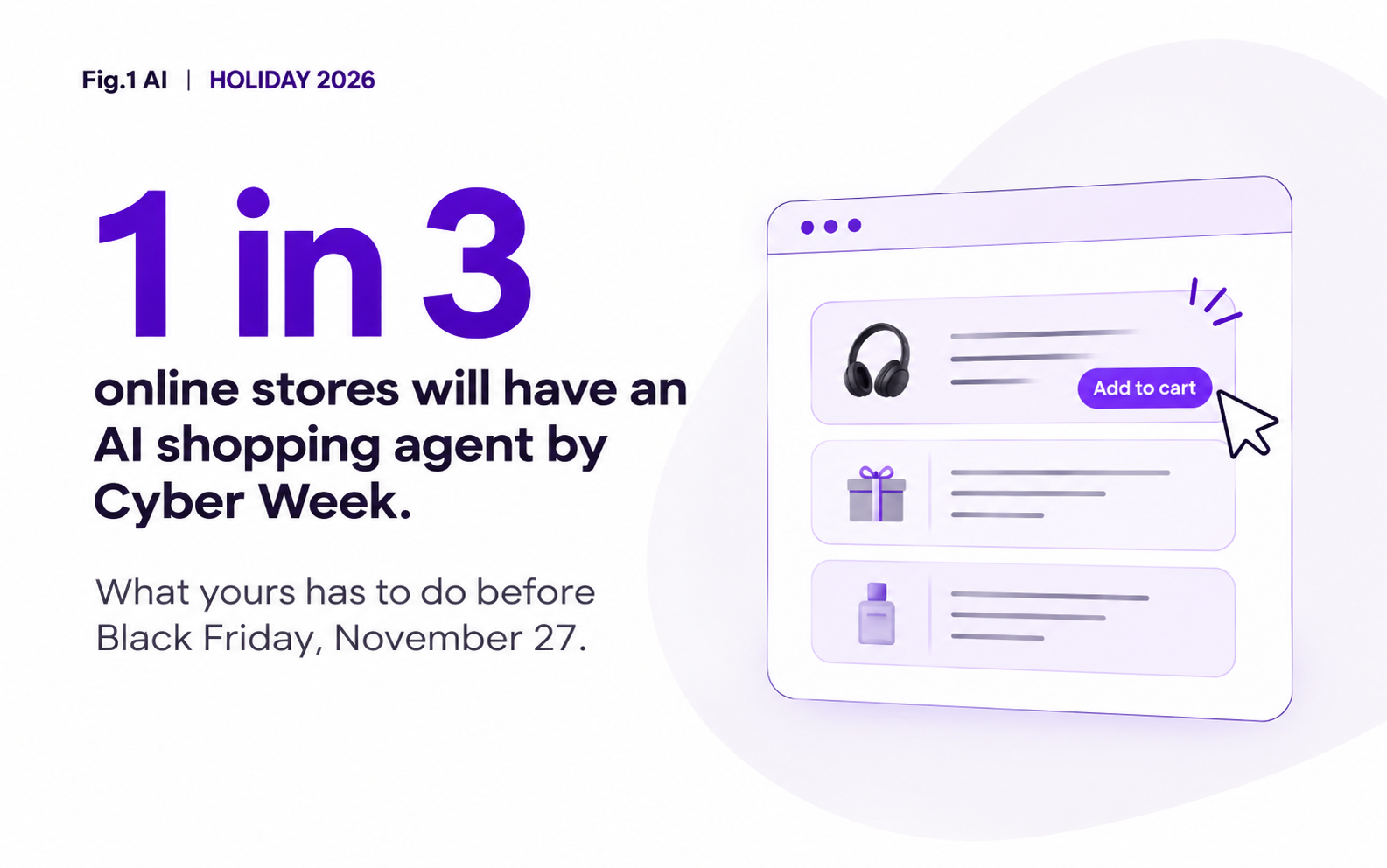
One in three ecommerce stores is expected to have an AI shopping agent by Cyber Week 2026. The question isn’t whether AI will change how people shop. It’s whether your store is ready for how they’re shopping now.
Imagine two online stores selling the same product.
A customer visits the first store looking for a Christmas gift. They’re not entirely sure what to buy, so they browse a few categories, read some descriptions, and eventually leave.
At the second store, they ask a simple question:
“I’m looking for a gift for my husband. He’s into fitness, but he already has all the usual equipment. What would you recommend?”
An AI shopping agent asks a follow-up question, recommends three relevant products, explains why each might be a good fit, and gives the customer a direct path to purchase.
Same customer. Same buying intent. Two very different shopping experiences.
This is where ecommerce is heading, and the 2026 holiday shopping forecasts suggest the shift is happening faster than many retailers expected.
AI Shopping Agents Are Becoming a Holiday Shopping Essential
According to Salesforce’s 2026 holiday shopping predictions:
- 20% of holiday ecommerce traffic is expected to originate from AI chat agents.
- One in three ecommerce websites is expected to have its own AI shopping agent by Cyber Week.
- Retailers using branded AI shopping agents saw holiday sales grow 6.2% last season, compared with 3.9% for retailers without them.
Adobe’s 2026 holiday forecast points in the same direction.
Traffic to U.S. retail websites from AI tools is projected to increase 130% year over year, with especially significant growth around Thanksgiving, Black Friday, and Cyber Monday.
Adobe also forecasts $275.1 billion in U.S. online holiday spending between November 1 and December 31.
These numbers tell us something important.
AI isn’t just changing how retailers operate behind the scenes. It’s changing how customers discover products, evaluate options, and make purchasing decisions.
And retailers need to prepare for both sides of that change.
There Are Two AI Shopping Trends. Most Retailers Are Only Preparing for One.
When people talk about AI transforming ecommerce, they often combine two different developments.
The first is AI-assisted product discovery.
A customer asks ChatGPT or another AI assistant to recommend a laptop, compare running shoes, or find a gift under $100.
The assistant helps narrow the options and may direct the customer to a retailer’s website.
The second is AI-assisted shopping on the retailer’s own website.
This is where an AI shopping agent works directly with the customer, using the store’s actual products, prices, policies, and inventory information to help them make a decision.
The distinction matters.
An external AI assistant might help someone discover your store.
But what happens once they arrive?
If a customer lands on your website with a specific question and can’t find an answer, the fact that AI helped them discover your business doesn’t guarantee a sale.
Getting discovered is only the beginning. Helping the customer make a decision is where the opportunity lies.
That’s why the next generation of ecommerce websites won’t simply display products.
They’ll help people shop.
The Real Problem With Ecommerce Isn’t Always Traffic. It’s Unanswered Questions.
Retailers spend enormous amounts of money bringing customers to their websites.
They invest in search engine optimization, paid advertising, social media, influencers, and email marketing.
But what happens when a potential customer arrives and needs help?
Consider a few common shopping questions:
- “Which one would you recommend for a beginner?”
- “Will this work with the model I already own?”
- “Can I get this delivered before Christmas?”
- “What’s the difference between these two products?”
- “Is this a good gift for a seven-year-old?”
These aren’t necessarily customer support questions.
They’re often buying questions.
The customer is interested. They’re evaluating a purchase. They just need a little more information before committing.
Traditional ecommerce websites expect customers to find those answers themselves.
An AI shopping agent can help remove that friction.
Instead of forcing shoppers to navigate product categories, search through FAQs, or wait for customer support, an AI agent can provide relevant answers and recommendations in the moment.
And that matters because the best time to help someone make a purchase is when they’re already considering it.
Why AI Shopping Agents Could Make a Difference to Holiday Sales
Salesforce’s research found that retailers using branded AI shopping agents experienced 6.2% holiday sales growth, compared with 3.9% among retailers without them.
That’s approximately 59% faster growth.
It’s an interesting comparison, although it doesn’t prove that AI agents alone caused the difference.
What it does suggest is that retailers investing in more helpful digital shopping experiences may be better positioned to capture demand.
Customer confidence offers another clue.
Salesforce reports that 41% of shoppers say a brand-owned AI assistant makes them much more confident in a purchase, while another 36% say somewhat more confident.
Think about why.
Shopping online removes the salesperson from the equation.
There’s nobody standing beside the customer to explain the difference between products, recommend an alternative, or answer that final question before checkout.
A well-designed AI shopping agent brings some of that guidance back into the experience.
Not by pretending to be human.
By making the website more useful.
The opportunity isn’t to replace the shopping experience with a chatbot. It’s to make online shopping feel less like searching and more like being helped.
Your Customers Are Shopping When Your Team Isn’t Working
There’s another problem that becomes especially relevant during the holidays.
Customers don’t necessarily shop during business hours.
We recently analyzed customer conversations across 78 live Fig.1 AI agents over a 30-day period.
The finding?
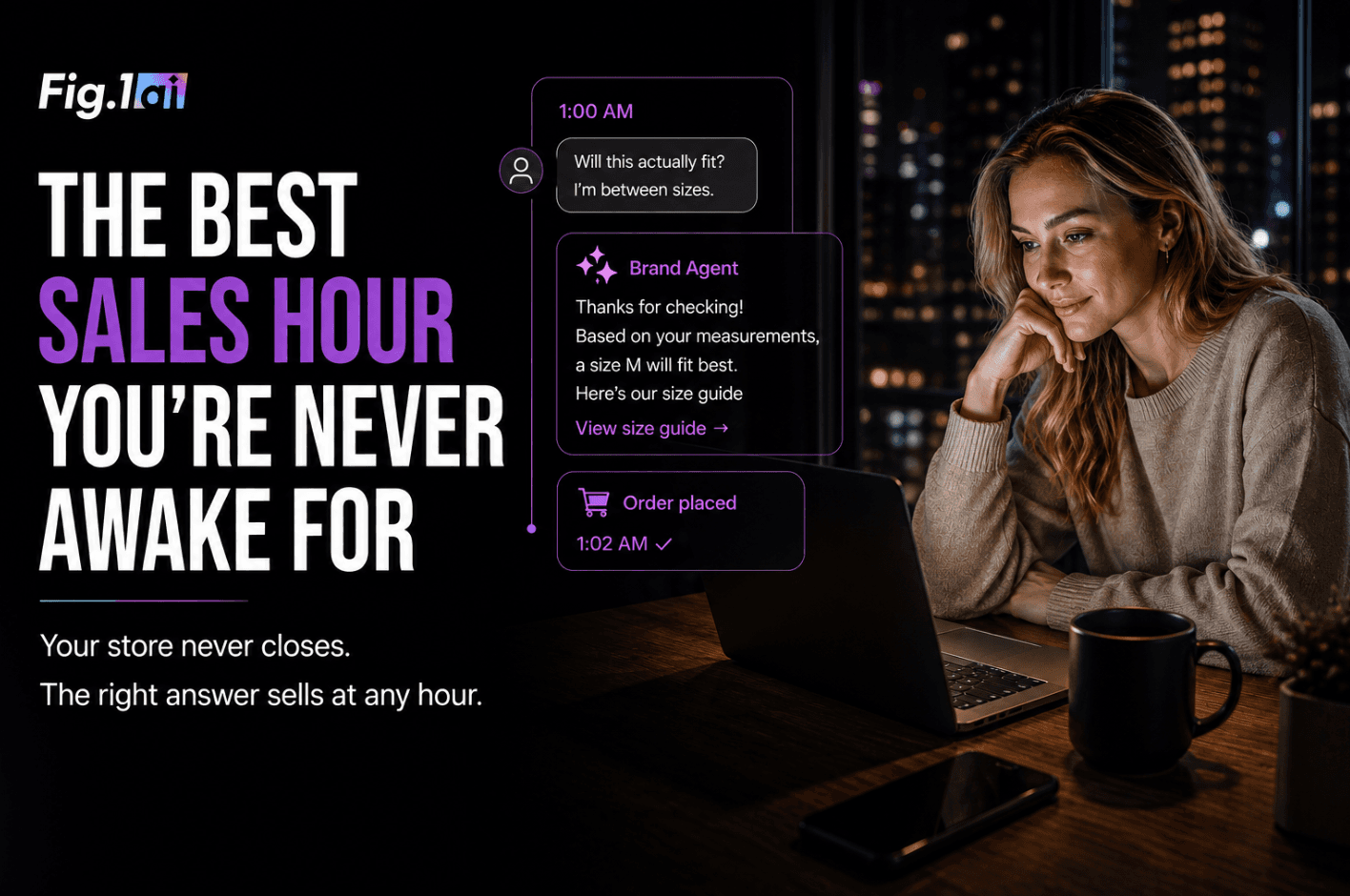
More than half of customer conversations started outside traditional 9-to-5 business hours.
One in ten started on a weekend.
These were real questions from people looking for information about products, services, availability, and pricing.
For ecommerce retailers, the implication is significant.
Someone browsing your store at 9:30 PM might be ready to make a purchase.
But if they have a question about sizing, shipping, or compatibility, they may not want to wait until the next morning for an answer.
They can simply open another tab.
An AI shopping agent gives retailers a way to engage those customers immediately, even when their team has gone home.
It can answer questions, recommend products, and guide shoppers toward checkout without requiring someone to be online.
And during the holiday season, when evenings and weekends are important shopping periods, that availability becomes even more valuable.
What Should an AI Shopping Agent Actually Do?
Not every ecommerce chatbot is a shopping assistant.
Many traditional chatbots are designed to answer basic support questions, direct visitors to help articles, or collect contact information.
Those functions are useful.
But an AI shopping agent should go further.
Here are five capabilities retailers should prioritize.
1. Recommend Products, Not Just Return Search Results
Imagine a customer asking:
“I’m buying my first espresso machine. Which one would you recommend?”
A basic chatbot might return a list of espresso machines.
A useful AI shopping agent should understand the customer’s needs.
It might ask about budget, experience level, or whether the customer prefers convenience over customization.
Then it should recommend relevant products and explain the differences.
The goal isn’t to show customers everything you sell. It’s to help them find what they’re most likely to buy.
2. Show Products, Not Just Talk About Them
A recommendation is much more useful when the customer can see the product.
An effective AI shopping assistant should be able to display product images, pricing, descriptions, and links directly within the conversation.
Rather than sending someone back to a search results page, it can present a small selection of relevant options.
The customer can compare them, ask another question, and continue toward checkout.
This is especially important on mobile, where long text responses can make shopping more difficult rather than easier.
3. Understand Your Actual Products and Policies
An AI shopping agent needs access to accurate information about the business it represents.
That includes:
- Product specifications and descriptions
- Pricing and availability
- Shipping policies and holiday delivery deadlines
- Returns and exchanges
- Promotions and product compatibility
An agent that confidently gives the wrong answer about Christmas delivery can create a much bigger problem than one that simply admits it doesn’t know.
Retailers should prioritize agents that can be updated easily as products, promotions, and policies change.
4. Answer the Questions That Prevent Purchases
Some of the most valuable shopping interactions are surprisingly specific.
- “Will this fit a 13-inch laptop?”
- “Does this come assembled?”
- “Can I use this with my existing equipment?”
- “Is this available in another size?”
These questions might seem small.
But to the person asking, the answer could determine whether they buy.
A useful shopping agent should recognize when someone is trying to resolve a purchasing concern and provide a clear, accurate response.
This is where AI can move beyond customer support and become part of the sales experience.
5. Help Customers Take the Next Step
Answering questions is important.
But the conversation shouldn’t end there.
If a shopper finds the right product, the agent should make it easy to view that product or proceed toward checkout.
If they need more help, it should provide a clear way to contact the team.
And if they’re interested but not ready to buy, an appropriate lead-capture option can help the business continue the conversation.
The goal is simple.
Don’t make customers start their shopping journey over after they’ve already told you what they want.
Can Small Ecommerce Businesses Actually Afford AI Shopping Agents?
Until recently, building a personalized shopping assistant could require substantial development work.
Retailers might need custom integrations, conversational AI development, product database connections, and ongoing technical support.
That’s changing.
No-code AI agent platforms now make it possible for businesses to create shopping experiences using their existing product information and brand content.
For smaller ecommerce businesses, this changes the economics.
You no longer necessarily need an enterprise-level technology budget to offer customers personalized product guidance.
With Fig.1 AI, businesses can create branded AI agents trained on their own products, policies, and content.
Instead of limiting customers to text-based responses, agents can deliver relevant information through text, images, video, and interactive product experiences.
They can also support customers across different touchpoints, including a brand’s website and social media.
For retailers, the objective isn’t simply to add another technology tool.
It’s to make the shopping experience more helpful without adding more work for the team.
Black Friday 2026 Is Almost Here. What Should Retailers Do Now?
Black Friday falls on November 27, 2026, followed by Cyber Monday on November 30.
For retailers preparing for the holiday rush, there are a few practical priorities.
Start by reviewing the questions customers already ask.
Look at customer service emails, website inquiries, Instagram messages, product reviews, and abandoned-cart feedback.
Where do shoppers seem uncertain?
What information do they repeatedly request?
Which questions could prevent someone from completing a purchase?
Next, make sure your product information and holiday policies are accurate and accessible.
Finally, consider whether your website makes it easy for shoppers to get personalized help.
An AI shopping agent doesn’t need to replace your entire ecommerce experience.
It can start by solving a few important problems: helping customers find products, answering common buying questions, and making it easier to take the next step.
The Future of Ecommerce Isn’t Just More Automated. It’s More Helpful.
For years, ecommerce innovation has focused on making transactions faster.
Fewer checkout steps. Better search. Smarter recommendations. Faster payments.
AI shopping agents introduce another possibility.
What if the website could actually help customers decide what to buy?
What if shoppers could describe what they needed in their own words and get a useful answer?
What if the business could respond to those questions at 10 PM on a Sunday, without adding another employee?
That’s the opportunity.
The retailers that benefit most from AI won’t necessarily be the ones with the most sophisticated technology.
They’ll be the ones using it to make shopping easier.
Your customers are already changing how they shop. The question is whether your website is changing with them.
Give Your Customers a Better Way to Shop
Fig.1 AI helps brands turn their websites into more interactive shopping experiences with AI agents that answer questions, recommend products, and help customers take the next step.
Explore what a Fig.1 AI agent could do for your business.
Sources
Salesforce, 2026 Holiday Predictions, July 20, 2026.
Adobe Digital Insights, 2026 Holiday Shopping Forecast, September 28, 2026.
Fig.1 AI internal production data, 78 live agents, October 5 to November 4, 2026.